At the end of January, global markets were dealt two major blows in succession, after a relatively positive start to the year. The first came from Chinese start-up DeepSeek, which announced it had developed a generative AI model at a fraction of the cost that US tech giants were spending. The second was US President Donald Trump’s announcement of punitive import tariffs on major trading partners. Until then, markets had been relatively hopeful that Trump would introduce more business-friendly policies.
Economic data released earlier in the month pointed to tentative growth and a slowdown in inflation across major economies, creating hope for further interest rate cuts this year. This sentiment has since shifted to concern about a possible trade war.
In the US, December CPI was 2.9% year-on-year, in line with expectations, with signs that stubbornly high shelter inflation may be slowing. In the Eurozone, core inflation for December was unchanged at 2.7%. Although this exceeded the European Central Bank’s target, it did not prevent the bank from cutting rates by 25 bps at the end of the month. Meanwhile, China continued to battle against deflation, with CPI up a mere 0.1% in December. However, recently-announced stimulus measures may already be having an impact. In December, Chinese industrial production rose by 6.2% year-on-year and retail sales rose 3.7% year-on-year.
In South Africa, December headline inflation was 3% year-on-year from 2.9% in November, while retail sales were buoyant at year-end. These reflected both Black Friday purchases and possible additional spending funded by two-pot retirement system withdrawals. At the end of the month, the South African Reserve Bank cut the repo rate by 25 bps to 7.5%.
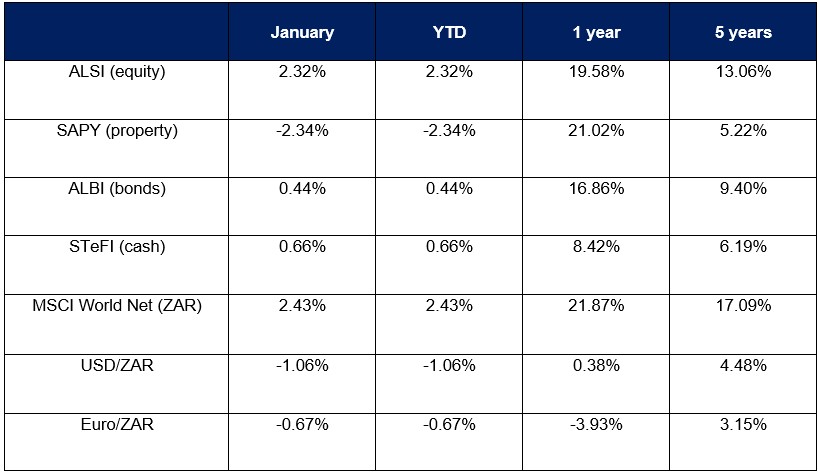
On 23 January 2025, the US S&P 500 Index reached a new record high above 6 100 points, but it quickly lost ground in the following few days. After some early setbacks, the JSE All-Share Index gained 2.32% for the month, bringing its one-year return to 19.58%. It was outperformed by property stocks, represented by the SAPY, which retreated 2.34% in January but showed a gain of 21.02% over one year. Domestic bonds have also rewarded investors on a one-year view, with a return of 16.86%.
The combination of a weak rand and the dominance of US markets in the MSCI All-World Index made a rand investment in the MSCI World Net the top performer in both the short and long term. On a one-month view the MSCI World Net has returned 2.43% and over one year it has returned 21.87%. Table 1: Total returns to 31 January 2025